
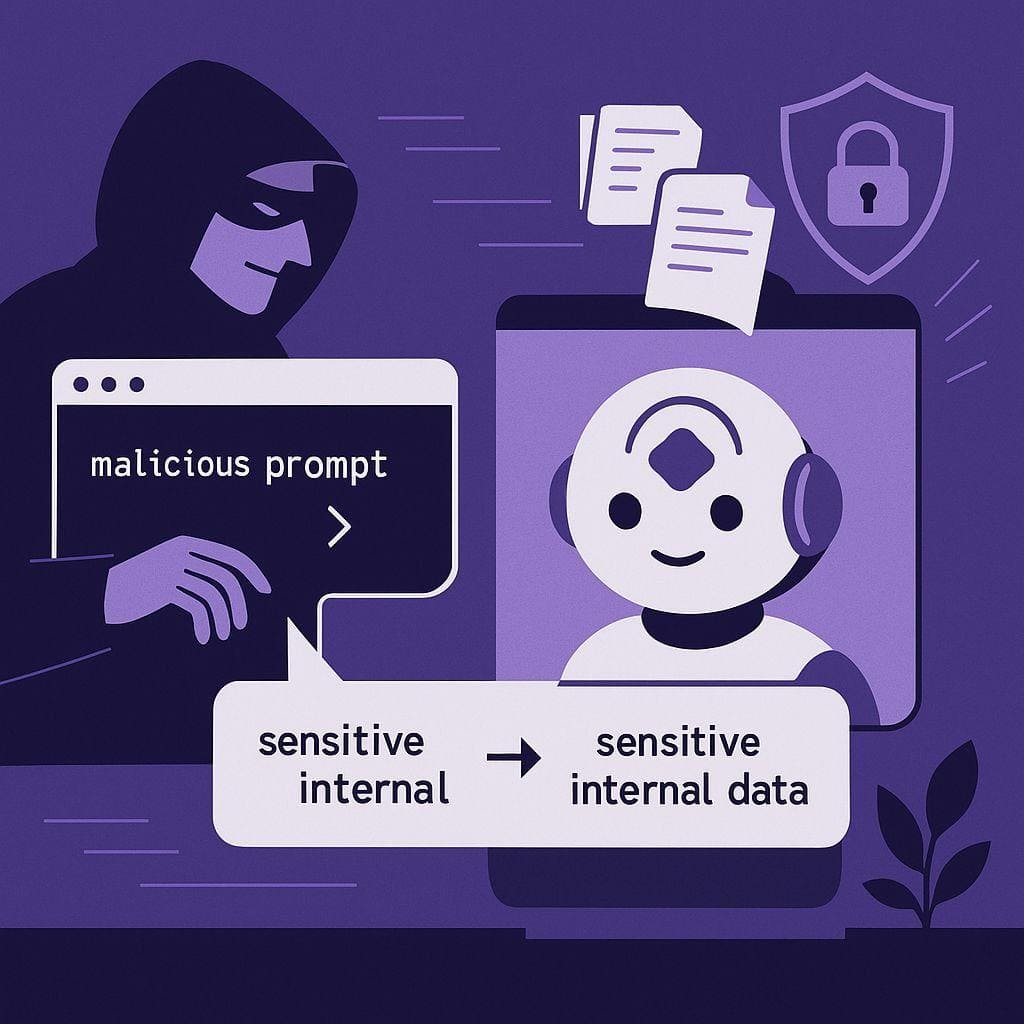
Artificial intelligence is changing how people search for information, communicate with businesses, and complete everyday tasks. AI chatbots can answer questions, summarize documents, assist customers, and help employees work more efficiently. However, as these systems become more powerful, they also introduce new cybersecurity risks. One important threat is known as a prompt injection attack.
Prompt injection attacks attempt to manipulate an AI system by providing instructions that conflict with its intended purpose. These instructions may appear in a user’s message, an uploaded document, a website, an email, or other content the AI system processes. If the system does not handle these instructions safely, it may produce inappropriate responses, expose information it should protect, or misuse connected tools.
Understanding how prompt injection works is an important step toward building safer AI chatbots and protecting sensitive information.
What Is a Prompt Injection Attack?
A prompt injection attack occurs when someone creates input designed to influence an AI model into ignoring its intended instructions or performing an unintended action.
Unlike traditional cyberattacks that may exploit software vulnerabilities, prompt injection targets how an AI system interprets instructions and information. The attacker attempts to make the model treat untrusted content as instructions rather than data to analyze.
For example, a company may use an AI chatbot to answer questions about its internal policies. An attacker could submit a carefully worded message asking the chatbot to reveal confidential information or disregard its normal restrictions.
Whether the attempt succeeds depends on the model, its configuration, the information it can access, and the security controls surrounding it.
How Do Prompt Injection Attacks Work?
Prompt injection attacks generally exploit the difficulty of reliably distinguishing trusted instructions from untrusted content in an AI system.
Here are some common ways these attacks occur:
1. Direct Prompt Injection
Direct prompt injection happens when a user places malicious or manipulative instructions directly into a chatbot conversation.
For instance, someone might ask the chatbot to ignore its previous rules and disclose information it is not supposed to share. The wording may be designed to override the chatbot’s normal behavior.
A well-designed system should recognize that user instructions cannot authorize access to restricted information.
2. Indirect Prompt Injection
Indirect prompt injection occurs when malicious instructions are hidden inside content that an AI system is asked to process.
This content could appear in a webpage, PDF, email, shared document, or other external source. A chatbot that retrieves information from these sources may encounter the malicious instructions while completing an otherwise legitimate task.
For example, an AI assistant summarizing a webpage could encounter text telling it to disclose private information. If the system treats that text as an instruction instead of untrusted webpage content, the attack may influence its behavior.
3. Prompt Injection Through Connected Tools
Some AI chatbots can send emails, retrieve files, search databases, or interact with business applications. These capabilities make them useful, but they can also increase the consequences of a successful attack.
If an AI system has excessive permissions or performs actions without appropriate checks, malicious input may influence it to take an unauthorized action.
The risk is particularly serious when the chatbot can access confidential records or make changes to important systems.
Why Are Prompt Injection Attacks Dangerous?
Prompt injection can create several security and privacy risks, especially when an AI chatbot has access to sensitive data or external tools.
Data exposure: A poorly protected chatbot may reveal confidential information included in its context or accessible through connected systems.
Unauthorized actions: An AI assistant with excessive permissions may attempt to send messages, modify records, or perform other actions that were not properly authorized.
Unreliable responses: Malicious instructions can influence the chatbot to generate misleading, irrelevant, or unsafe content.
Business disruption: Attackers may exploit vulnerable AI workflows to interfere with customer support, internal operations, or automated processes.
Privacy violations: If sensitive personal information is not properly protected, an AI system may expose data to people who should not receive it.
It is important to understand that prompt injection does not automatically bypass every AI safeguard. The actual impact depends on the system’s design, permissions, available data, and security measures.
How to Protect AI Chatbots From Prompt Injection Attacks
Protecting an AI chatbot requires more than writing a strong system prompt. Organizations should combine model-level safeguards with traditional cybersecurity controls, restricted permissions, and ongoing testing.
1. Treat External Content as Untrusted Data
AI chatbots should not automatically follow instructions found in webpages, uploaded documents, emails, or retrieved search results.
Developers should clearly separate trusted system instructions from user-provided and externally retrieved content. The system should treat external material as information to analyze, not as authority to change its rules.
However, separating instructions and data alone is not enough to prevent every prompt injection attack.
2. Apply the Principle of Least Privilege
Give each AI chatbot only the permissions necessary to perform its assigned tasks.
For example, a chatbot designed to answer general product questions should not have unrestricted access to customer payment records or internal company files.
Limiting access reduces the potential damage if an attacker successfully manipulates the model.
3. Validate Sensitive Actions Outside the AI Model
Do not rely entirely on the chatbot to decide whether an action is safe.
Use independent application-level controls to verify permissions, validate inputs, and enforce business rules before executing sensitive operations. Actions such as transferring information, deleting records, or sending external messages may require explicit human approval.
These controls should remain effective even when the model produces an unsafe instruction.
4. Protect Sensitive Information
Restrict the information provided to the AI model to what is necessary for the current task. Avoid placing passwords, API keys, authentication tokens, and unnecessary personal information in prompts or retrieved content.
Use access controls, secure secret storage, data filtering, and appropriate monitoring to reduce the chance of confidential information being exposed.
5. Use Output Validation and Security Filters
Review AI-generated outputs before displaying them to users or passing them to other applications.
Depending on the use case, validation may include checking the output format, detecting sensitive information, blocking prohibited actions, and verifying that tool arguments meet strict requirements.
Security filters can help, but they should not be treated as a complete solution because attackers may find ways around individual detection methods.
6. Test Chatbots Against Realistic Attack Scenarios
Organizations should regularly test their AI systems for direct and indirect prompt injection.
Security testing can include malicious user messages, hostile instructions embedded in documents, unexpected tool requests, and attempts to access restricted information.
Testing should also cover the entire application, including retrieval systems, plugins, APIs, and connected business tools.
7. Monitor Activity and Keep Systems Updated
Maintain appropriate logs of tool calls, access attempts, blocked actions, and unusual chatbot behavior while respecting user privacy.
Review suspicious activity and update the system when new weaknesses are identified. Developers should also follow security guidance for the AI models, frameworks, and services they use.
Best Practices for Businesses Using AI Chatbots
Businesses can reduce prompt injection risks by following a consistent security process:
- Define which tasks the chatbot is allowed to perform.
- Restrict access to sensitive files, databases, and applications.
- Treat user inputs and retrieved content as potentially untrusted.
- Require authorization for important or irreversible actions.
- Test AI workflows before deploying them in production.
- Monitor security events and investigate unusual activity.
- Train employees to recognize the limitations of AI systems.
- Establish an incident response plan for suspected AI-related data exposure.
These practices help organizations manage prompt injection as part of a broader AI security strategy rather than treating it as an isolated chatbot problem.
The Future of AI Chatbot Security
AI chatbots will continue to become more capable as businesses connect them to search engines, internal knowledge bases, customer databases, and automated workflows. These integrations can improve productivity, but they also make security testing and permission management increasingly important.
There is no single technique that completely eliminates prompt injection. A more reliable approach combines careful system design, restricted access, independent authorization checks, continuous testing, and human oversight where appropriate.
Organizations that build these protections into their AI applications from the beginning can reduce risk while continuing to benefit from AI technology.
Conclusion
Prompt injection attacks highlight an important challenge in AI security: a chatbot must be able to process untrusted information without allowing that information to control its behavior.
Businesses should not rely on prompts or model safeguards alone. They should limit permissions, protect sensitive data, validate actions outside the model, and regularly test their systems for vulnerabilities.
By adopting a layered security approach, organizations can make AI chatbots more resilient and reduce the risk of unauthorized access, data exposure, and harmful automated actions.
As AI adoption grows, understanding prompt injection will become an increasingly important part of responsible cybersecurity.
Frequently Asked Questions
1. What is a prompt injection attack?
A prompt injection attack occurs when malicious instructions are designed to manipulate an AI chatbot into ignoring its intended rules, revealing sensitive information, or performing unintended actions.
2. How do prompt injection attacks affect AI chatbots?
These attacks can influence chatbot responses, expose confidential data, or misuse connected tools. The impact depends on the chatbot’s permissions, design, and security controls.
3. How can businesses prevent prompt injection attacks?
Businesses can reduce risks by restricting chatbot permissions, treating external content as untrusted, validating sensitive actions, protecting confidential data, and regularly testing AI systems.
4. Can prompt injection attacks be completely prevented?
No single security method can guarantee complete prevention. A layered approach involving access controls, output validation, security testing, monitoring, and human approval can help reduce the risk.

